Tong's talk at the Ecological Society of America 2025
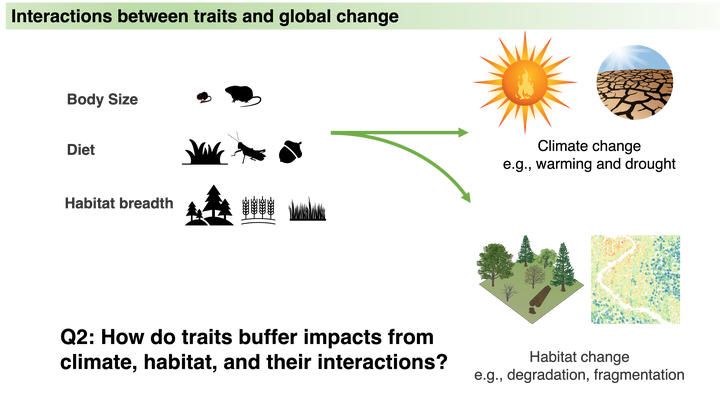
Tong’s abstract: Small mammals play crucial roles in ecosystem services and functions, including seed dispersal, pollination, and nutrient cycling. Their activities facilitate forest regeneration, enhance plant diversity, and contribute to soil fertility, indirectly supporting carbon sequestration and habitat provision. Current efforts to anticipate changes in small mammal populations incorporate various environmental variables but often overlook the fundamental requirement of food supply. The food-consumer relationship become even more complex when we consider the roles of ecosystem structure, which not only shapes the habitat, affecting the abundance, activity, and cover available to many consumers, but also act as buffers, mediating the impacts of climate change through climate-habitat interactions (CHI). Additionally, different traits such as habitat breadth, diet breath, body size, and fossoriality could determine species response to CHI. This study aims to answer two questions to fill these knowledge gaps: 1) How does habitat modulate climate change impacts on abundance of small mammals? 2) How do traits mitigate impacts from climate, habitat, and their interactions? We synthesized airborne hyperspectral and LiDAR remote sensing with biodiversity sampling of more than 60 species across NEON within a generalized joint attribute model. We found that habitat characteristics, including LiDAR-derived understory density and hyperspectral-derived canopy lignin, are significant sources of variation in both species’ abundance and community-weighted mean traits. The habitat-trait interactions revealed four major species groups. Grassland herbivores respond negatively to canopy lignin, particularly in cold climates. Shrubland frugivores benefit from open habitats in cold climates but not in warmer ones. Large-bodied granivores show decreased abundance with dense understory, and these negative effects are amplified by ECOSTRESS-derived moisture stress. Furthermore, the widely distributed species Peromyscus maniculatus is projected to decrease under future climate change scenarios, especially in closed canopies with high canopy lignin. Because ecosystem structure and canopy nutrients are under the control of managers, these results have direct implications for biodiversity conservation.


Hanshi Chen
Ph.D. student
My research interest focuses on remote sensing of ecology.