Tong's Talk at the Ecological Society of America 2024
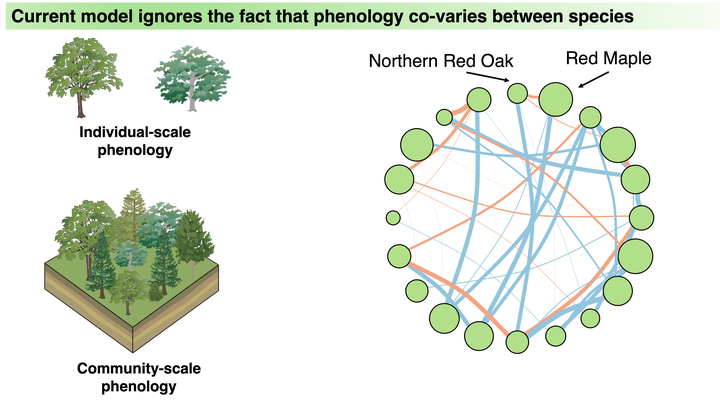
Tong’s abstract: Understanding the drivers of plant phenology, the intra-annual rhythm of the start, progression, and ending of vegetation activity, is a goal of global change research. Previous work mostly focused on the relationship between phenology and climate factors, but species responding to the climate are interacting with other species that also respond to their environment. Current modeling efforts rarely incorporate these effects of species interactions, due to the large investment needed for field measurements on both phenology and biodiversity variables. To what extent does species interaction modulate climate impacts on plant phenology? How do different species respond to the changing climate? To answer these questions, we synthesized phenological observations from more than 130K phenological records of 90 species from the National Ecological Observatory Network (NEON) and the National Phenological Network (NPN) across the United States. We integrated the data within a Generalized Joint Attribute Model (GJAM) to investigate the effects of temperature and precipitation on the timing of leaf senescence. We found that biodiversity modulates plant phenology across different communities, where the influences differ by species groups, growth forms, and geographical distributions. Precipitation contributes the most variations in the timing of fall senescence, but less precipitation-sensitive species tends to exhibit stronger response to the growing season temperature. We also found related species, especially in the Quercus and Acer genera, tend to have a coherent pattern in their sensitivities. Southern species that have a longer growing season tend to be more sensitive to environmental changes compared to their northern counterparts. Interestingly, incorporating species interactions in the joint species model increases explained variance by more than 30%. Species interactions are critical in modifying plant phenology response to climate change and should be considered in modeling plant phenology across different scales.

Hanshi Chen
Ph.D. student
My research interest focuses on remote sensing of ecology.