Tong's talk at the American Geophysical Union fall meeting 2025
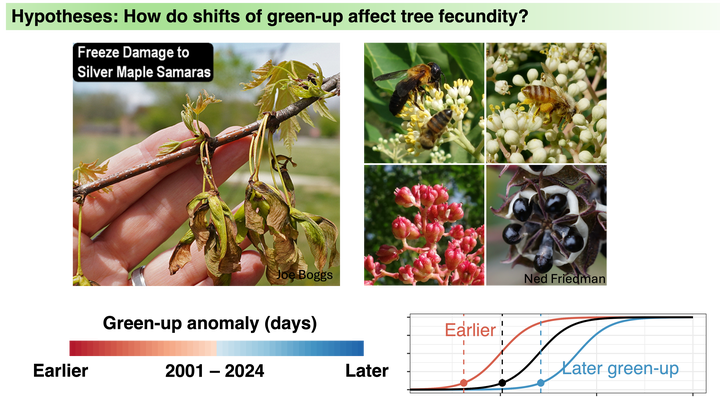
Tong’s abstract: Understanding the drivers of tree reproduction that measures the regeneration potential of forests is a goal of global change research. Phenology is the intra-annual rhythm of the start, progression, and ending of vegetation activity. The timing of spring green-up could affect seed production through its effects on pollen production (e.g., the phenological synchrony hypothesis). However, evidence supporting this hypothesis is still limited to a few locations and few species, due to the large investment needed for field measurements on both variables. Are wind-pollinated species more sensitive to spring green-up than animal-pollinated species? Are masting species (i.e., volatile, quasi-synchronous seed production at lagged intervals) responding more to spring green-up than non-masting species? Which year of spring green-up is the most important for genera that have multiple years of seed development? To answer these questions, we synthesized seed production data from the Masting Inference and Forecasting (MASTIF) network with the remotely sensed timing of spring green-up in the temperate and boreal forests. Species concentrates more of its reproductive output in years with earlier spring green-up in a large majority of genera, with notable exceptions in Fagus, Liriodendron, and Juglans. Consistent with this finding, seed production also increases at sites that have advanced timings of green-up. We did not find differences in within-species response to spring green-up between wind- and animal-pollinated species. Similarly, the most volatile species are not those having the highest sensitivity. Spring green-up in the current year has a larger influence on seed production in the white oaks compared to that in red oaks, perhaps related to the 2-year seed development in red oaks. For conifers with multiple years of seed development, spring green-up in the current year (t), the prior year (t-1), and the 2 years prior (t-2) have similar effects on the 3-year Pinus. Spring green-up in t-1 and t is equally important for the 2-year genera Tsuga and Picea but not for Abies. The timing of spring green-up is expected to be further advanced due to contemporary warming, these findings have broad impacts on the understanding of tree production and how it might influence future forest regeneration in a changing climate.


Yu Shen
Postdoc Associate
My research interest focuses on remote sensing of ecology.

Hanshi Chen
Ph.D. student
My research interest focuses on remote sensing of ecology.