Tong's invited talk at the Duke SCAI 2026 meeting
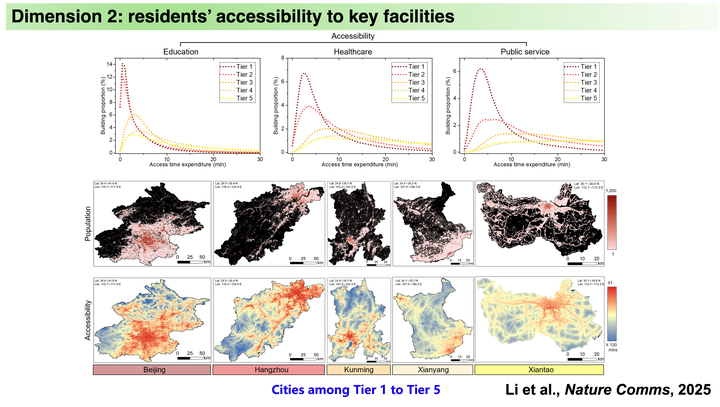
Tong’s abstract: China’s urbanization has unfolded at unprecedented speed—rising from ~21% urban population in 1978 to ~66% in 2024—while the benefits of growth have been unevenly distributed. This talk presents a deep learning approach to quantify urban inequality. First, I introduce a new national-scale, building-level map of urban functions in China, which classifies individual buildings into eight categories. The product fuses multi-source remote sensing, including night-time lights, high-resolution optical imagery, and building height, with training labels from existing points-of-interest and building footprints and validation using statistical records, yearbooks, and ground-sampled reference points nationwide, independently. Using these data, we quantify disparities in (i) urbanization intensity (height, density, lighted area), (ii) accessibility to essential facilities (education, healthcare, public services), and (iii) 15-minute living circles that capture neighborhood-level amenity diversity and convenience across city tiers and within-city gradients. Together, these analyses offer actionable insights for equitable urban planning.