Phenological Responses to Canopy Structure Depend on Vegetation Biomes Across the United States
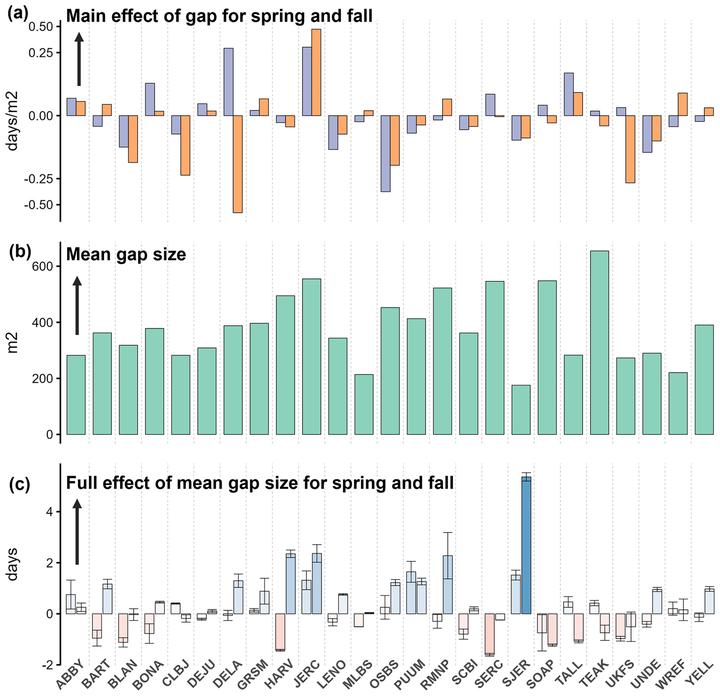 Site-level effects of canopy gaps on phenology (in days). (a) Unstandardized main effects of canopy gaps for spring (purple) and fall (orange). The y-axis follows a square-root scale to improve visibility of small-magnitude coefficients. (b) The average area of canopy gaps within each site (m2). (c) Full effects on spring (left bar) and fall phenology (right bar) (days)
Abstract
Land surface phenology is a key indicator of ecosystem responses to global change, but most studies largely emphasized temporal trends, leaving spatial patterns, particularly those shaped by canopy structure, underresolved. As disturbances from forest dieback, invasive species, and wildfire expand canopy openings that reshape microclimates, their consequences for the timing of spring green-up and fall senescence remain poorly quantified. Leveraging multi-source remote sensing data from 25 sites in the National Ecological Observatory Network (NEON), we evaluated how canopy gaps and their interactions with climate affect phenology across diverse biomes with a Bayesian spatially explicit model. Gaps were associated with earlier spring and later fall phenology in 15 and 18 sites, respectively; tropical seasonal and temperate rainforests showed delays in both seasons, whereas temperate seasonal forests generally advanced spring and delayed fall, and woodland/shrubland advanced spring but exhibited mixed fall responses. At typical average gap sizes (200 to 650 m2), spring green-up shifted by −2 to +2 days and autumn senescence by −1 to +5 days, with climate background modulating both magnitude and direction in some sites. Our models also achieved high out-of-sample accuracy (R2 > 0.5 at 21 of 25 sites for spring and 20 of 25 for fall), highlighting canopy structure as a key driver of spatial variations in phenology. Because canopy structure can be modified through silvicultural practices, these findings provide actionable guidance for climate-resilient forest management.

Hanshi Chen
Ph.D. student
My research interest focuses on remote sensing of ecology.