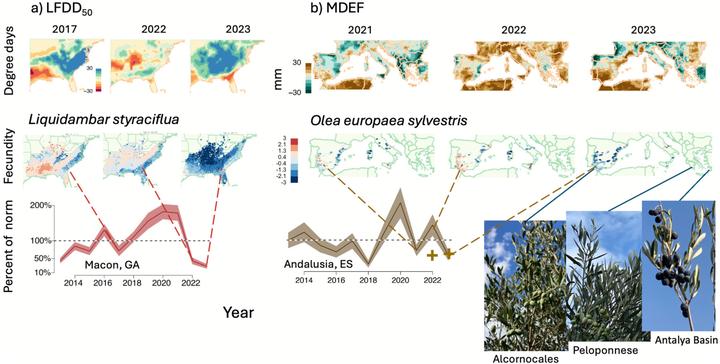
 Anomalies associated with commercial losses compared with forests. Examples species show losses in late-freeze years (blue LFDD in a) and drought years (red, brown MDEF in b). Map colors saturate at 3SD of the mean on a log (proportionate) scale. Each dot on fecundity maps aggregates seed production (log kg/ha) from inventory plots (Methods). Shaded intervals in time series are 95% for annual crop averages with respect to the mean for both series. (a) Mapped anomalies for sweetgum (L. styraciflua) fecundity (center) track mapped LFDD anomalies for the strongest declines in peach-harvest years. (b) Wild olive (O. europaea sylvestris) maintains productivity in regions where commercial harvests were hard-hit by drought, with wild crops still above the norm in 2022. Commercial harvests in 2022/2023 are indicated by the plus sign (Ministerio de Agricultura 2024). Map shading is absent from Greece and Türkiye, which lack inventory data. Photos from three regions of commercial harvest failures show productive wild olive crops in 2023. Map lines delineate study areas and do not necessarily depict accepted national boundaries. [photos JSC]
Abstract
In 2023, more than half of olive harvests (Olea europaea) across Spain, Greece, and Türkiye were lost to drought. The same year late freeze destroyed 90% of the peach crop (Prunus persica) on the Georgia Piedmont and the apple crop (Malus domestica) in central New York, Vermont, and southern Quebec. Climate extremes now rank with the costliest threats to agriculture, but their role in forest recovery from diebacks that are happening globally is unknown for lack of tree fecundity estimates in forests. Tolerance of climate extremes could depend on past exposure but constrained by phylogenetic conservatism. We report a continental scale analysis of climate extremes and forest fecundity across North America and Europe showing that responses to late freeze and drought are happening now. Species differences are not explained by the traits typically included in ecological studies and they are weakly associated with phylogeny. Late freeze, that is, freezing temperatures that follow the onset of flower development in spring, is shown to be “normal” in North America, but not Europe, potentially explaining failed seed production due to delayed onset and the resultant shorter growing period by North American transplants dating back at least to the 18th century. Drought has thus far had the greatest impacts in dry forested regions, but here too, species differences are not explained by traditional trait values. If responses have been buffered from drought and late freeze by past exposure, acclimation and local adaptation prove inadequate as extremes intensify