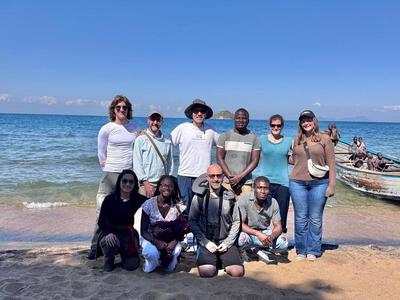
The Qiu lab conducted field sampling in Malawi for the NSF project
Our team is conducting fieldwork in southern Malawi as part of a multi-institutional project focused on addressing a central scientific question: What are the ecological benefits and/or trade-offs from restoration interventions in communal forests and agroforestry systems?
To answer this, we have completed ecological sampling across a network of community-managed forest and agroforestry plots. In the communal forests, we conducted biodiversity surveys by documenting species presence and identity, measured herbaceous biomass through grass and forb clipping, and carried out detailed tree inventories, recording species, location, and tree size. We also collected soil cores to analyze nutrient content and evaluate soil health. In the agroforestry plots, we focused on tree inventories and soil core sampling. Our field team includes Aubrey, Steve, Christopher, and Linda.
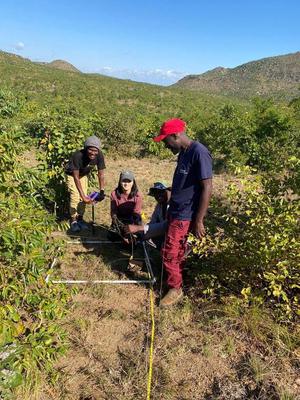
These data provide a critical foundation for understanding how different restoration strategies influence biodiversity recovery, ecosystem productivity, and soil quality. Our findings will inform evidence-based restoration practices and guide land-use policy, not only in Malawi but also in dryland regions across sub-Saharan Africa.
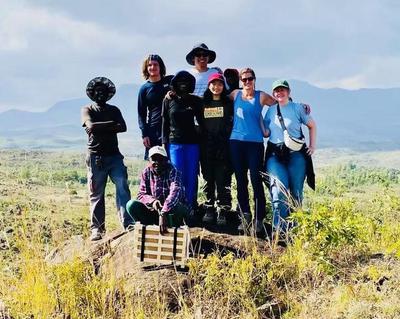
Looking ahead, we will integrate our field measurements with satellite remote sensing and ecological models to assess restoration outcomes across broader spatial scales. This will allow us to evaluate long-term ecological trajectories and predict how restoration efforts may respond to future environmental and land-use changes. In addition to our work in Malawi, we plan to expand data collection to South Africa next spring, enabling comparative analysis across different restoration and biogeographical contexts in sub-Saharan Africa.