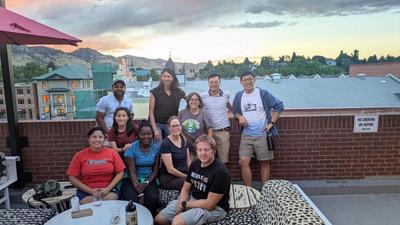
The Qiu lab participated the ESIIL MacroPhenology working group
The background of the working group: Given the sensitivity of plant phenology to environmental change, there is an urgent need to quantify plant phenological dynamics to better understand and predict this societally important biological phenomenon. For example, berry phenology is important to Indigenous peoples of Alaska, as are the timing of flowering and fruiting of many native species. Various types of data capture information on plant phenology (e.g., community science observations, observatory network data, remotely sensed observations, herbarium specimens); but rarely are these data types integrated. Without such integration, our knowledge of changes in phenology across time and space is limited. For instance, it is unknown how phenological change will affect species distributions and developmental events in ecosystems or if it will differentially favor nonnative species. Such understanding will help predict shifts in species distributions as well as aid in conservation. We will focus on the interaction between phenological shifts and species range shifts in response to climate change, using multiple sources of data and co-production with Indigenous peoples to further knowledge of how climatic change may alter plant phenology and range changes.
The background of ESIIL: The Environmental Data Science Innovation & Impact Lab (ESIIL) enables a global community of environmental data scientists to leverage the wealth of environmental data and emerging analytics to develop science-based solutions to solve pressing challenges in biology and other environmental sciences. ESIIL holds inclusion as a core principle and method for diversifying environmental data science at a time when society needs all perspectives, and science needs to serve all. ESIIL’s research community generates discoveries and novel approaches through: 1) cutting-edge team science, 2) innovative tools and collaborative cyberinfrastructure, 3) data science education and training, and 4) building inclusive participation and diverse groups. These activities advance the frontier of environmental data science, a rapidly evolving discipline bridging the computational, biological, environmental, and social sciences.
Hanshi is going to lead a paper on within-species varaition in rate of phenology of both spring and autumn season.