The Qiu lab is supported by Data+/Climate+ program to produce AI-enabled forest species maps
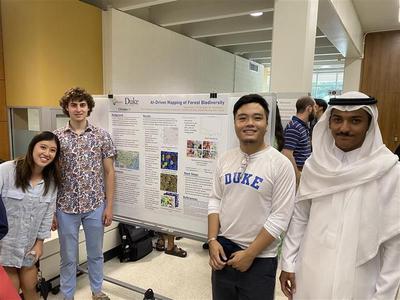
A team of three undergraduate students—Georgiy Zemlevskiy, Hashim Abdulrahman Alrefaei, and Sophie Mao—led by postdoctoral associate Zhuohong Li, used cutting-edge remote sensing data, including hyperspectral imagery and airborne Light Detection and Ranging (LiDAR), together with an advanced deep learning framework to improve forest biodiversity monitoring. The team identified key spectral and structural features for tree species discrimination and developed an AI-based species classification model. This project established a foundational dataset for large-scale assessments of how forest biodiversity responds to climate change, with important implications for conservation planning and ecosystem management under rapid global change. The students presented their final poster at the Climate+/Data+ symposium.
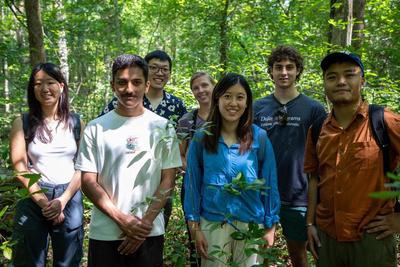
We also conducted a field visit to Duke Forest with the full team, including Ivy Geng (left) and Jordan Luongo (Clark Lab manager, center). The site visit helped students connect remote sensing products with on-the-ground ecology and better understand why both field sampling and airborne observations are essential for this work.